heavily involved in a community writing project. We're putting together a series of short radio plays based on village life. There are several of us on-board - writers, editors, actors, organisers - and we have episode 1 written up and a storyboard for episode 2. It's a completely new direction for me. I've never done radio plays before, or any kind of collaboration.
embarking on an audiobook production of Hamelin's Child via Amazon's ACX programme. I have a narrator now and once we sort out contracts, I expect to be involved in a lot of work listening to and editing chapters.
trying to finish a short story for an anthology deadline. It's not a commission so it's not really a deadline, is it?
mulling over ideas for Ratline, which will be the next book in Lenny's story after Rat's Tale. Maybe 4k down so far, but no plot to speak of as yet...
And then of course there's the usual June/July madness of birthdays, anniversaries and the awesome weird and wonderful event that is the Moulton Crow Dance at Crow Fair on July 12th. Once again my house looks like a terrorist training camp with stacks of black costumes and black hoods with slits for eyes....
How many times have you watched a film or television show, or read a
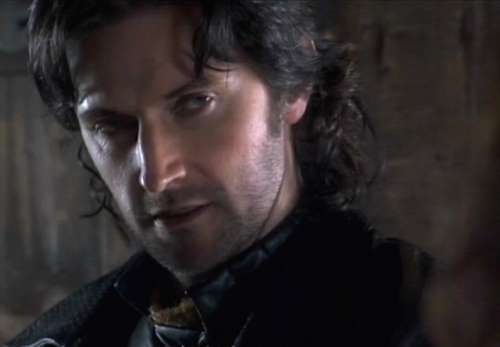
book and been just a little bit in love with one of the bad guys? Think Sean Bean in Patriot Games, Richard Armitage’s unbelievably sexy Guy of Gisborne in the BBC’s Robin Hood, or even Heathcliff in Wuthering Heights, who wasn’t exactly the type of boy you’d taken home to meet your mother.
I confess the title isn't mine. I nicked it off my good friend Jan Edwards. But it just seemed to sum up how I feel about the current trend in anything to do with writing, genre fiction, the convention circuit: the circles I move in - or used to move in. I'm a bit more square these days, I think...
Gender Parity.
With capital letters.
Read any write-up of a genre convention and there'll be somebody banging on about it. How there were more men than women on this panel, more male guests than female guests and don't the organisers know that there are women writers too? Whole pages devoted to listing all the awesomely good ladies.
Anthologies are the same. Oh no - there are twenty stories and only two written by women! Surely that depends on the ratio of publishable stories that were actually submitted by women? Even committees are getting in the act. Must have an equal balance etc etc. It's bad enough in real life when the public sector talks about how many women there are in higher-management roles and are we under-represented because we took time out to have a family?
Now don't get me wrong. I'm all for women's rights and equality of opportunity. But the key is that word - opportunity. Take for example a hypothetical fiction anthology calling for submissions. It should be open to men, women, people who identify as either gender. After that it's surely down to the quality of the work submitted? Gender of author becomes irrelevant - in the same way that race, religion and any other identifying characteristic is irrelevant to the ability to write a good story. It's the same with panels at conventions and conferences; I want to listen to what somebody has to say because they have a valid and/or interesting contribution to make - not because they are a man or a woman and are there to make up numbers.
Frankly I find it all rather insulting. I don't want to be given preferential treatment because I'm female. I don't want to think people might be muttering she only got there because of her sex. I want to be on a panel or in an anthology or selected for anything in my life because somebody thinks I'm actually rather good at it. Because I am.
So Rat's Tale is now live in ebook format at amazon.co.uk and amazon.com. The paperback and other sites should be there in the next few days hopefully.
Lenny’s turned his back on the past. In return for police protection and
a lighter sentence, he’s grassed up his old gangland boss and he’s
hoping that eventually he’ll be free to start a new life with Amanda.
But the past isn’t giving up on him yet. New man on the block Mick
Carlotti fancies himself as a crime lord – he doesn’t have the contacts
or the business acumen, but he knows a man who does. He also knows
exactly how to get Lenny to play ball.
Caught between Carlotti’s rock and the hard place of a life sentence
for a murder he didn’t commit, Lenny’s running out of choices. Turning
his life around is going to be a lot harder than he thinks.
Set just after events in Calling the Tune, this shorter novel is Lenny's story and contains adult material.
This one's been fun. Getting inside the head of a bad-boy and working out what makes him tick has been fascinating and not something I've done before. I think it works ...
Use all five senses and write about spring. 10 minutes - go!
It's so close, I could touch it. At least I could if the window opened more than the inch or so required for "ventilation" - although really it's just to drop fag ends outside. But I like to stick my fingers out and touch the rain, or get my nose so close to the gap that I can smell and taste the weather. It's a better smell than body odour and boiled cabbage. Freedom is something I can see through the glass, but always just out of reach. I can hear traffic sometimes, on a still night when the morons on the wing finally quit carping and curl up in something approaching sleep, tucked up under their dirty grey blankets with their dirty grey dreams. Cars in the distance, people travelling, arriving, living; without freedom, I simply exist. But spring is somehow different. Always full of hope with the promise of summer just around the corner. I always stick my fingers out of my cell window when it rains in the spring.
I was lucky enough to get invited to this event as a guest author with an access-all-areas "artist" pass and the chance to witter on at great length on stage about genre writing - and my genre writing. You can read more of this side of the event on 6th April in my monthly blog over at AuthorsElectric, but here I thought I'd talk more about cosplay and role-playing in general.
Up until recently, I'd never even heard the term cosplay. While I've been to (and organised) many conventions over the years, they've been more aimed at the literary and art side of the science fiction, fantasy and horror genre - more concerned with discussion, readings and art shows. This is the first event I've attended that celebrates the shows themselves, where 6000+ attendees turn up to meet stars and dress up as their favourite characters. I used to do a lot of live role-play (of the Treasure Trap variety), but other than a brief and uncostumed appearance at a Star Trek convention in the early 1990s, I've never experienced such a large group of people having so much fun with costumes before.
Witness Peter Capaldi's new incarnation of Dr Who arguing at great length with a dalek over which of them is the bigger star and has the biggest BBC contract; Pennywise the clown wandering through the arena menacingly, with his clutch of balloons; a blue-skinned woman browsing books in the dealer room, Willy Wonka watching a panel or Obi-Wan Kenobi doing battle with Darth Vader by the outdoor bar.
And that's not doing homage to the steampunk crowd in their beautifully-detailed Victorian outfits. Men and women - whole families having a weekend away from television, playstations and the internet, and mixing with like-minded people. I could have stood outside all weekend just watching the interplay, the impromptu re-enactments of scenes from film and television.
In the trading area, I was helping to man the Telostable. The stand across the way had a whole wall of artwork - mostly by the wonderful fantasy artist Rodney Matthews, whose posters papered my walls in my student days (who remembers Athena posters in the early 1980s?). And I had a complete fangirl moment when I realised that the man himself was there, helping to run the stall! So I had a chat with him and bought a signed print. Totally made my weekend!
Would I go again? Definitely. Not sure I'd dress up myself. I did feel sorry for the cosplayers on occasion - everywhere they went, they'd stop to pose and have their photograph taken. But I guess that's what it's about for some of them - the appreciation of the onlookers into the sheer amount of effort it's taken to put some of these outfits together and the character-playing throughout the entire weekend. Hiding behind a persona can be fun in that you can do all sorts of things the real you would never dare to do! Which is kind of what we do when we write isn't it? Put on another identity and experience life as somebody else.
A bit of googling and I find that the classic line to illustrate plot is attributed to EM Forster:
The king died and then the queen died is a narrative.
The king died and then the queen died of grief is a plot.
It's about cause and effect. Actions leading to events which lead to further actions - at the end of which the people involved are changed in some way - be it physically or mentally. They fall in love, they solve the mystery, they realise that their values have changed, they reach some kind of understanding or enlightenment. All good stories - genre and literary fiction - follow this path in some way, whether the characters reach a literal or spiritual destiny.
Taking it a stage further - events need to be a direct result of a character's actions. How many times have you read stories where a character sits passively while things happen to him? Not very often, I expect. Character generates plot which in turn changes the character. It's why deus ex machina endings are so frustrating - God in the machine - where in classical literature, the Gods would walk onto the page and determine the ending. In modern fiction it's where the characters wake up and it's all been a dream. Or where the murderer is revealed to be somebody's twin brother that's never been mentioned in the story. As a reader you feel cheated and justifiably so. Events have to be connected - cause and effect.
In a short story, it's the difference - for me, anyway - between a story and a piece of prose. A piece of prose is words on a page or screen, in the right order. It may be beautifully written with wonderful imagery - but if it doesn't end, figuratively speaking, in a different place from where it started, it's not a story. There's no change, no growth, no enlightenment in the character or even reader. That's not to say there is anything wrong with pure prose - I just don't like seeing the two confused.
I find this really hard sometimes. I'll be writing a scene and I'll suddenly realise that everything is happening around my character and he has no direct influence on any of it. With the nature of the stuff that I write, it's quite common, and yet the good guys have to escape/outwit the bad guys by virtue of something they themselves initiate. Otherwise what was the point? Calling in the cavalry is the easy option.
And while I don't always have happy endings, I do try to make them satisfying within the context of the story. But never walking off hand in hand into the sunset!